Over the past two decades, the rules of the Search Engine Optimization (SEO) game have remained relatively stable: analyze keywords, build backlinks, and optimize page load speeds. However, with the aggressive entry of ChatGPT, Perplexity, and Google AI Overviews (AIO), we are in the midst of the largest paradigm shift in search technology since its inception. Search is no longer just about “clicking links”; it is about “obtaining immediate, precise answers.”
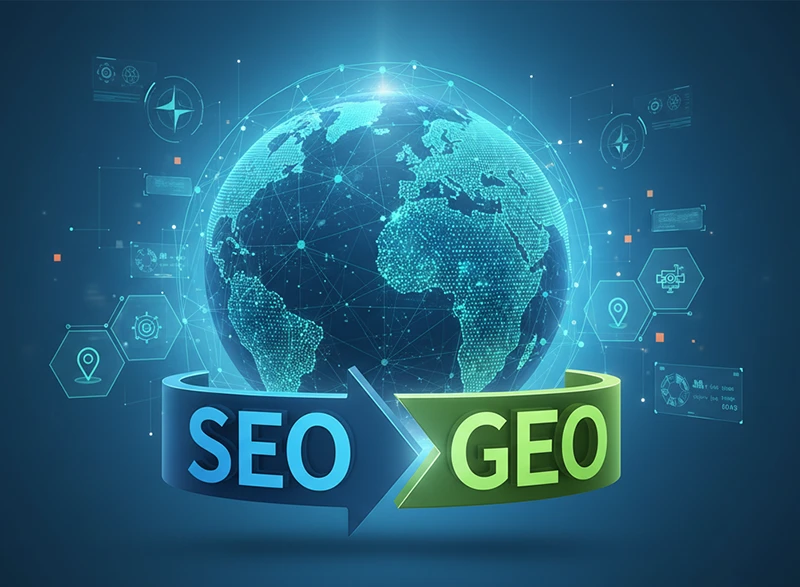
For B2B enterprises, this revolution is both a threat and an opportunity. Gartner’s latest prediction is sobering: by 2026, traditional search engine traffic is expected to drop by 25%. This means that if businesses remain stuck in old SEO mindsets, they face the risk of a shrinking digital footprint. HeyaDigi believes that now is the critical moment to shift the battlefield to GEO (Generative Engine Optimization).
Table of Contents
The Shift in Search Paradigms: From “List of Links” to “AI Direct Answers”
The role of traditional search engines is to be a “guide,” telling users where they can find answers. In contrast, Generative AI acts as the “answerer,” directly digesting hundreds of web pages to produce a tailored summary for the user.
Google AI Overviews (SGE) and the Restructuring of Search Engine Results Pages (SERP)
When Google launched AI Overviews (AIO), the area “Above the Fold” on search result pages became almost entirely occupied by AI-generated content. According to research by Seer Interactive (2025), when AIO appears, the click-through rate (CTR) for the first organic search ranking plummets from an average of 1.76% to 0.61%—a staggering 61% decrease. This marks the full-scale explosion of “Zero-click Searches.” Data from Similarweb further indicates that in May 2025, the proportion of zero-click searches climbed to 69%.
Why Do B2B Enterprises Face More Severe Challenges?
B2B procurement processes are typically long and complex, involving multiple decision-makers. In the past, decision-makers would search for numerous industry reports and product comparisons. Now, they are more likely to ask an AI: “Please compare the cost-effectiveness of Software A and Software B in a manufacturing scenario.” If your brand is not part of the AI’s corpus or summary, you won’t even have a chance to make it onto the shortlist. This is no longer just a loss of traffic; it is a loss of brand authority.
Key Search Market Statistics for 2025
25%
Expected drop in traditional search traffic by 2026
61%
Drop in #1 spot CTR when AIO appears
69%
Proportion of Zero-click searches
40%
Increase in AI citation rate after adding GEO elements
Are Keywords Dead? The New Era of GEO (Generative Engine Optimization)
Keyword research is not disappearing, but its purpose has changed. In the GEO era, the focus is no longer on “exact word matching,” but on “becoming the AI engine’s preferred information source.”
What is GEO? How Does it Differ from Traditional SEO?
GEO is an emerging set of strategies designed to optimize content so that it is more easily captured, understood, and presented as a citation by Large Language Models (LLMs). While traditional SEO focuses on title tags, H1s, and backlink counts, GEO focuses more on the “fact density” and “authoritative relevance” of the content.
| Dimension | Traditional SEO (Search Engine Optimization) | GEO (Generative Engine Optimization) |
|---|---|---|
| Core Goal | Compete for top 3 SERP link clicks | Appear in AI summaries and gain citations |
| Key Techniques | Keyword density, metadata, external links | Content authority (E-E-A-T), Entity tagging, data citations, expert quotes, structured knowledge |
| Evaluation Metrics | Keyword rankings, organic traffic, CTR | AI Share of Voice, brand mention rate |
| Content Depth | Pages targeting specific search intent | Deep reports with Information Gain |
The Five Pillars of Increasing AI Citation Probability
According to GEO research from Princeton University and Georgia Tech, researchers found that certain content adjustments can significantly increase AI preference:
- Statistics: AI loves specifics. Providing exclusive market research data makes your content a “source of truth.”
- Quotations: Include commentary from industry experts. AI often cites attributed professional opinions to enhance the credibility of its responses.
- Depth: Avoid superficial answers. AI tends to summarize long-form articles that are content-rich and logically rigorous.
- Structure: Use clear hierarchical headings and lists to help models locate information in vector space.
- Fluency: Although AI can rewrite, content with a smooth, naturally professional tone is more likely to be selected as a benchmark.
5 Major GEO Strategies
1. Strengthening E-E-A-T: “Real Human Experience” That AI Cannot Replace
Google recently upgraded E-A-T to E-E-A-T, where the added “E” stands for Experience. In today’s flood of AI-generated content, authentic human experience is the only antidote to spam. Google’s E-E-A-T (Experience, Expertise, Authoritativeness, Trustworthiness) principle is even more critical in the GEO era. Generative AI tends to extract information from sources it considers “credible.” For B2B websites, this means clearly displaying author credentials, expert review mechanisms, and the brand’s standing in the industry.
Boosting “Experience”: Sharing Exclusive Case Studies
AI can generate generic advice on “how to achieve digital transformation,” but it cannot tell a reader: “When we executed a transformation for a semiconductor client in 2024, we encountered a technical bottleneck where Protocol A was incompatible with System B, and we eventually solved it using Method C.” This type of practical experience with “Information Gain” is exactly what Google and AI engines crave most right now.
Building “Authoritativeness”: Expert Bylines and Brand Footprints
SEO expert Aleyda Solis points out that SEO has shifted from keywords to “Entities.” Your company is not just a website; it should be a recognized “entity” on the web. This includes building consistent viewpoints across LinkedIn, Medium, professional forums, and Wikipedia (where possible). It also means the digital footprint of your company or brand. When an LLM repeatedly encounters the connection between your brand and a specific professional field (such as “supply chain automation”) during its training process, your authority increases in the AI’s weighting.
2. Optimize Content Structure and Fluency
AI models find it easier to understand text with clear structures and logical coherence. Overly colloquial or fragmented language (slang) may reduce the AI’s comprehension accuracy.
- Use clear H2/H3 heading hierarchies.
- Utilize bullet points to organize complex information.
- Provide “direct and concise” answer paragraphs for specific questions, which helps in being captured as “featured snippets.”
3. Target “Conversational Search” with Long-Tail Keywords
When users ask questions to ChatGPT or Perplexity, they usually use full sentences rather than fragmented keywords (e.g., “Compare the differences between SEO and GEO for the B2B software industry” vs. “SEO GEO difference”).
Therefore, content should include more Question and Answer (Q&A) formats and cover semantic keywords related to the topic to help the AI establish contextual relevance.
4. Technical Adjustments: How to Make AI Crawlers Love Your Website
Beyond content, the technical foundation needs to be upgraded for the AI era. We need to progress from simple “crawlability” to “understandability.”
Advanced Application of Structured Data (Schema Markup)
Traditional Schema markup is primarily used to generate Rich Snippets. In the GEO era, we should more extensively use About and Mentions tags. These tags explicitly tell the AI exactly which entity the article is about (e.g., a specific industry technology, software category, or geographic region), which effectively reduces the “hallucination” an AI might experience during parsing.
Managing Robot Protocols and APIs
Today’s traffic comes not only from Googlebot but also from GPTBot (OpenAI), PerplexityBot, and others. B2B enterprises should check their robots.txt to ensure these AI crawlers can access high-value white papers and blog content. Additionally, providing structured, up-to-date product information directly to AI platforms via API will become a mainstream trend in the future.
Case Study: GEO Implementation for a Multinational SaaS Company
Background: A B2B enterprise focused on cloud ERP discovered that although its core keywords ranked #1 on Google, its competitors frequently appeared in recommendation lists when users asked ChatGPT or Perplexity.
Strategy:
- Content Upgrade: Converted original 800-word product descriptions into 2,500-word “Industry Application Guides,” incorporating 15 sets of exclusive customer data.
- Expert Quotes: Invited the company CTO to provide deep insights (Quotes) on technical challenges in every article.
- Entity Correlation: Deployed comprehensive Person and Organization Schema across the website.
Results: Three months later, the brand’s citation frequency in Perplexity’s related questions increased by 310%, and the conversion rate of referral traffic from AI engine citations was 18% higher than that of traditional search.
5. New Goals for B2B Content Strategy: Becoming AI’s “Preferred Reference Source”
Future SEO success will no longer be measured solely by “traffic,” but by “influence” and “citation rate.”
From “Answerer” to “Thought Leadership”
Don’t just create encyclopedia-style content like “What is SEO,” because AI does that better than you. You should create content like “Three SEO Predictions for 2026” or “Why We Believe Current AI Search Models are Flawed.” When your viewpoint is unique and authoritative, AI engines are forced to cite your content to provide a comprehensive summary of different perspectives.
How to Measure SEO Success in the AI Era?
We recommend that companies start tracking these new metrics:
- AI Share of Voice: How many times your brand is mentioned by AI in response to questions in a specific field.
- Citation Conversion Rate: Behavioral analysis of users who enter the site via source links from AI engines.
- Branded Search Growth: Whether users actively search for your brand name after the AI mentions it multiple times.
Conclusion: Embrace Change, View AI as a Traffic Filter Rather than a Terminator
Alan Antin, Vice President at Gartner, once noted: “GenAI solutions are becoming ‘alternative answer engines.’ Enterprises must rethink their channel strategies.” The essence of SEO has never changed—it is about “providing value.” It’s just that in the AI era, the delivery of value has shifted from “direct clicks” to “authoritative citations.”
As a navigator in digital marketing, HeyaDigi‘s advice is clear: we should not fear AI taking away traffic, but rather proactively optimize our brand’s weight in the “AI brain.” Through GEO strategies, deep E-E-A-T content, and precise technical tagging, companies can build a moat that AI cannot easily destroy. This is not just about surviving next year’s search rankings; it is about becoming the leader that is trusted by AI, cited by experts, and chosen by customers in the future digital ecosystem.
Want to know how to create a custom SEO and GEO integrated strategy for your brand? Feel free to contact the HeyaDigi team and let us help you gain a firm foothold in the new wave of digital marketing.
Frequently Asked Questions
What is GEO (Generative Engine Optimization)?
GEO is an emerging optimization strategy aimed at increasing the exposure and citation probability of content within generative AI (such as ChatGPT, Perplexity, and Google AIO). It emphasizes data citations, expert perspectives, entity tagging, and information gain.
Will AI cause traditional SEO traffic to disappear?
Gartner predicts that traditional search traffic will drop by 25% by 2026. While traffic may decrease, the remaining traffic will be more precise, and AI-provided citations will become a new source of brand authority.
Will GEO replace traditional SEO?
No. GEO is an evolution and extension of SEO. The technical foundations of traditional SEO (such as site speed and structured data) remain vital for AI crawlers, but GEO emphasizes content authority, data evidence, and semantic structure more heavily. The two should complement each other.
How should B2B enterprises respond to zero-click searches?
Enterprises should shift from being simple ‘answerers’ to ‘thought leaders,’ providing exclusive case studies, first-hand data, and deep industry insights that AI cannot generate on its own. This ensures the brand maintains a presence in AI-generated summaries.